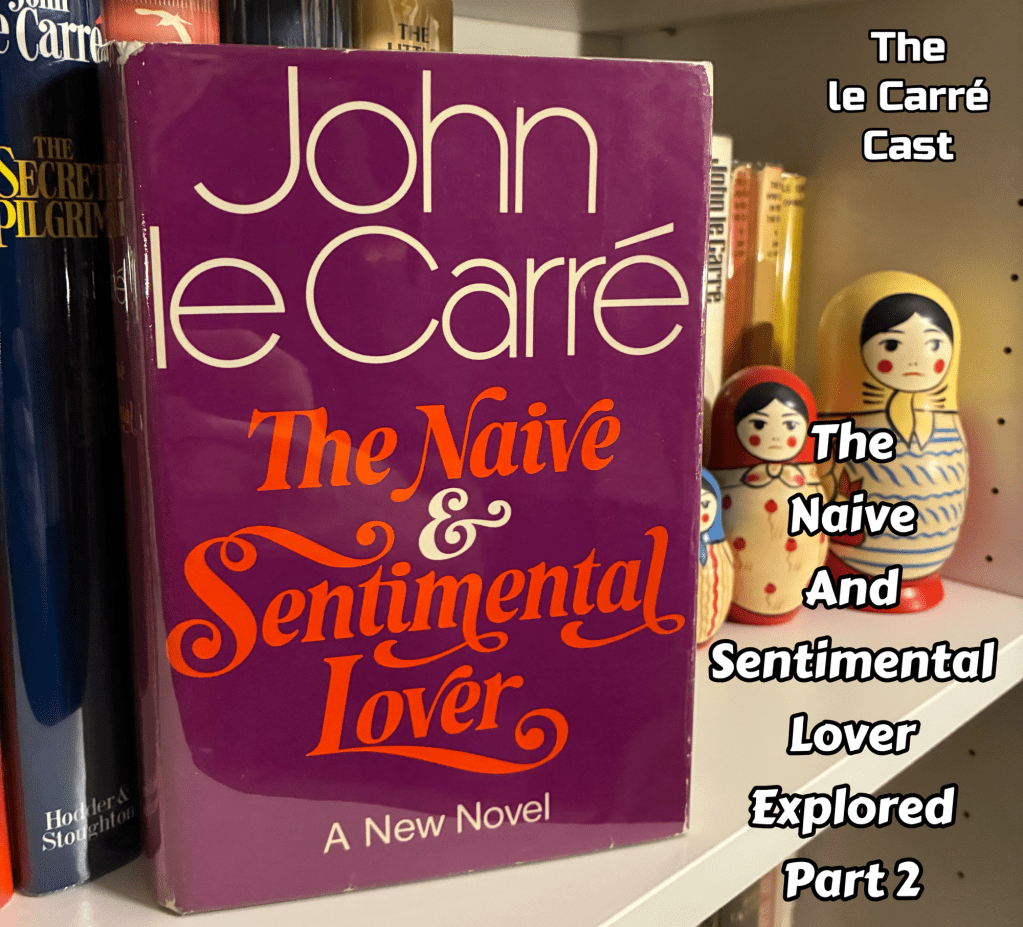
The Naive and Sentimental Lover by John le Carre – Explored Part 2

This episode we are back with author James Wolff to continue to discuss John le Carré’s novel The Naïve and Sentimental Lover.

We talk more about these characters, James Kennaway’s Some Gorgeous Accident, and the reality of marriage vs reality.

What song by a well known band is based on the novel? What did le Carré take away from the experience of writing the novel? And what should other writers take away from how it was received?

Plus, worst wedding in the world!

All that and more in this episode!

James’ Website – https://jameswolffauthor.com/

James’ new novel Spies and Other Godshttps://groveatlantic.com/book/spies-and-other-gods/

Find more on my Substack.

2 responses to “The Naive and Sentimental Lover by John le Carre – Explored Part 2”

  1. By way of brief introduction, I discovered this Podcast in September 2025 after reading “Our Game” for the umpteenth time, and looking online for some discussion of it. I first discovered John Le Carre in 1991, when I was required to read “The Spy Who…” for a high school class.

    I’ve since read all of his novels, including “The Naïve…” which I read for the first time 10-15 years ago now. My reaction to the book back then was essentially the same as that of Jeff and James: it was a slog to get through, I didn’t enjoy spending time with the characters (I found Shamus to be particularly insufferable), and I kind of hated it. I intended to never read it again.

    But this past October, I decided to read all of the Le Carre novels in chronological order, which is something I hadn’t done before. Among other things, this decision required me to violate my intention to never read “The Naïve…” again, and I just finished re-reading it yesterday.

    I’m both surprised and pleased to report that I appreciated (and perhaps, even enjoyed?) the book significantly more this time around than I did the first time. It didn’t feel like a slog the second time through and I was genuinely moved by the book this time. I think I can pinpoint three reasons for why reading it a second time was a more positive experience.

    (1) When I read the book the first time, I knew nothing about David Cornwell’s personal life, but between reading it the first and second times, I learned about Ronnie Cornwell, David’s love triangle with the Kennaways, his divorce from his first wife, etc. As a result, when reading the book a second time I could appreciate how Old Hugo was both David’s initial attempt to write a Ronnie character, and a precursor to Rick Pym. I was also able to view Aldo’s relationship with Shamus and Helen in light of David’s similar experience in his own life.

    These were helpful connections to make, in that I felt like I was learning more about David rather than just reading about random people I disliked and didn’t care about in any way.

    (2) I have come to interpret the book’s title in a more nuanced (and difficult to explain) way that contributes to my sense of what David was trying to accomplish in writing it. Having read the book a second time, I now pronounce the title in such a way that “Lover” refers specifically to Shamus’s nickname for Aldo, such that the book’s title can be interpreted as providing an answer to the question “Who is it that is naïve and sentimental?”, with the answer being “Lover”, as in, Shamus’s Aldo.

    In a sense, from the beginning of the book to the end, Aldo transitions from being just “The Sentimental Aldo” into becoming (at least somewhat) naïve in addition to being (strictly) sentimental. He also transitions into being “Lover”, in addition to being Aldo. For some reason, pronouncing “Lover” in the title to refer specifically to Shamus’s Aldo changes how I feel about the title, and the book.

    There are limits, though, on how “naïve” Aldo has become by the end of the book. He is nowhere near as naïve as Shamus, and from what I can tell his naivete is primarily manifested in his choice to allow himself to start (and continue) having sex with Angie and Heather (in addition to having at least a few better-than-previous-average sexual experiences with Sandra).

    Perhaps David himself became more naïve through his relationship with the Kennaways, and perhaps he found the experience of becoming a more naïve lover to yield the same combination of expanded sexual expression and freedom yet ultimate disappointment that it yielded to Aldo.

    (3) This last point leads me to the third reason that my second reading of the book was more positive than my first one, which is that I was more profoundly affected by the book’s ending the second time. When I finished reading the book the first time, I was simply relieved to be finished and to move on to something else. But with the knowledge of David’s own (unhappy?) love life in mind, the book’s ending is quite sad to me now, in a way that makes me appreciate the book’s ability to make me feel strong emotions that I didn’t feel the first time around.

    As someone who has been married to the same person for more than 25 years (and who is otherwise very inexperienced in romance), I can identify with much of Aldo’s own views of himself as an ineffectual lover and his quest for some kind of grand romantic Love beyond the confines of his “grey” marriage to Sandra. My own marriage is not that grey, but there is still a part of me that resonates with Aldo’s search for Love in the form of a Shamus and/or Helen. 

    The book’s ending seems to suggest either that Aldo found what he was looking for but wasn’t able to hold on to it, or that after finding what he was looking for, it didn’t fill the hole that he expected it to fill. In either case, his life after Shamus/Helen is clearly a very unhappy one, and perhaps reflects what David expected himself to experience in the remainder of his life as he was finishing the novel and divorcing from his first wife.

    I find it profoundly sad that Aldo never sees Shamus or Helen again, that he and Sandra live unhappily ever after, that he continues having affairs with Angie and Heather even though they don’t seem to make any meaningful contribution to his life, and, most of all, that his life is completely devoid of love.

    On that note, I find the final sentence of the book to be both heartbreaking and worthy of being acknowledged by all who read it as the emotional takeaway of the entire book.

    For Aldo, finding Shamus (and Helen) was tantamount to finding Love, for the first and only time in his life.

    Having lost Shamus (and Helen), then, for Aldo, and for Lover, choosing not to remember Shamus is a necessary act of self-protection and even survival, because to remember them was to remember something that he had never had before them and would never have again:

    “For in this world, whatever there was left of it to inhabit, Aldo Cassidy dared not remember love.”

    Like

    1. What a wonderful and thoughtful comment. Thanks for sharing. As you heard, I didn’t enjoy it as much as you did on your second read, but perhaps in several years I’ll come back to it with a different perspective!

      Like

Leave a comment